
SoundBar is out. It is the fourth Mac app I have shipped, after Flit, Vitals and Levers, and it does one thing macOS has never done: it gives each app its own volume.
Why macOS needs a volume mixer
macOS has one volume slider. The call, the song, the video in a browser tab and Slack’s notifications all share it. Turn the music down for a call and the call goes down with it. If a video was recorded too quietly, the only fix is to turn the whole Mac up, and then everything else is too loud.
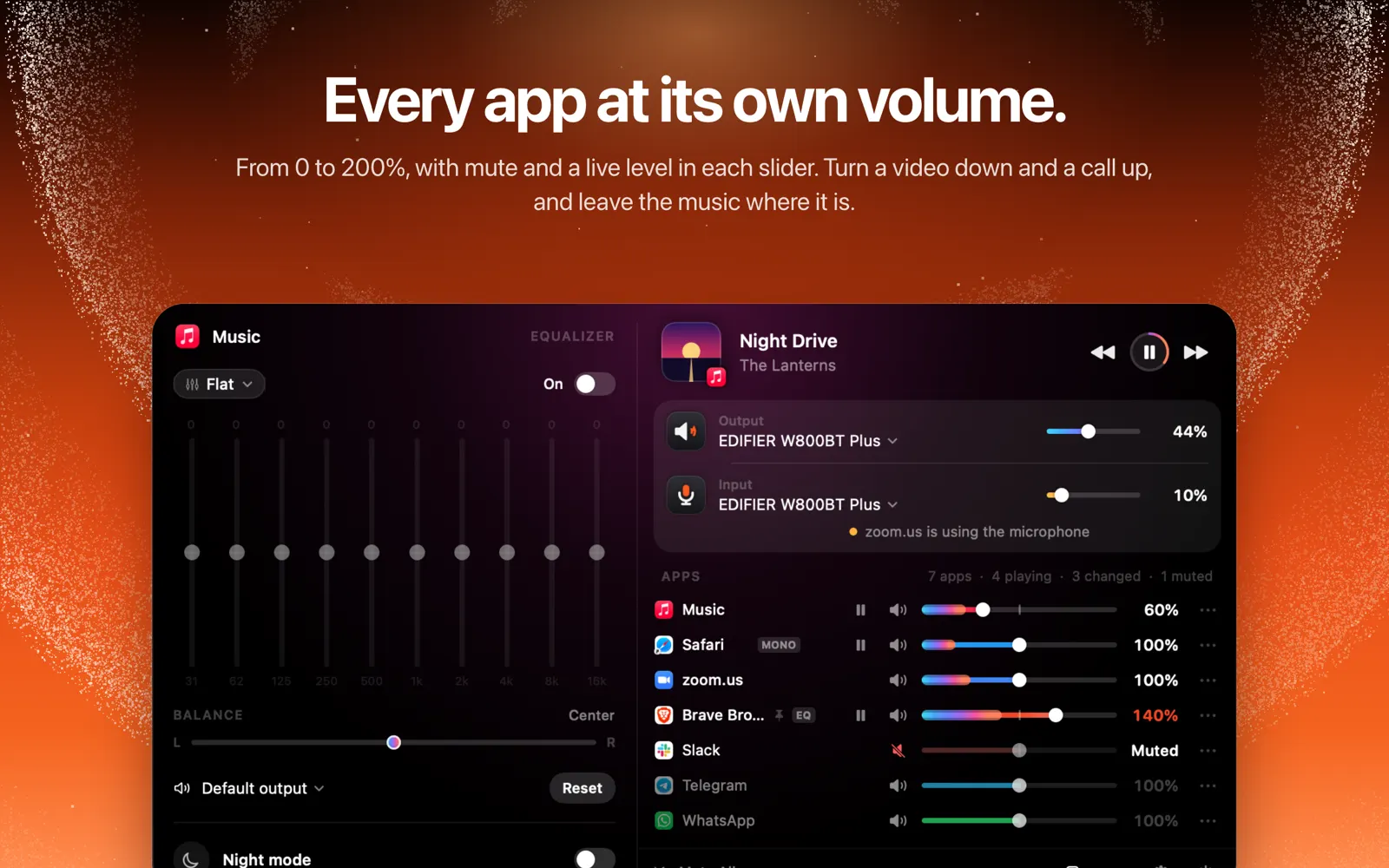
SoundBar gives every app that plays sound a slider of its own, from 0 to 200%, and a mute button. Turn a video down and a call up, and leave the music where it is.
A volume for each app, in the notch or the menu bar
On a MacBook with a notch, SoundBar lives in it. Hover over the notch, or click it, and it opens on the song that is playing, with its cover and previous, play and next, and under it every app that is playing, each with its own slider. All opens the rest: every app, the Mac’s output and microphone, and an equalizer for each app.
On a Mac or a display without a notch, the same mixer opens from the menu bar. On a MacBook you can choose either one, or have both.
Inside each slider is a live level, so you can see which app is making the noise before you reach for it. Past 100%, the slider gets brighter the further it goes. Each app keeps its volume between launches.
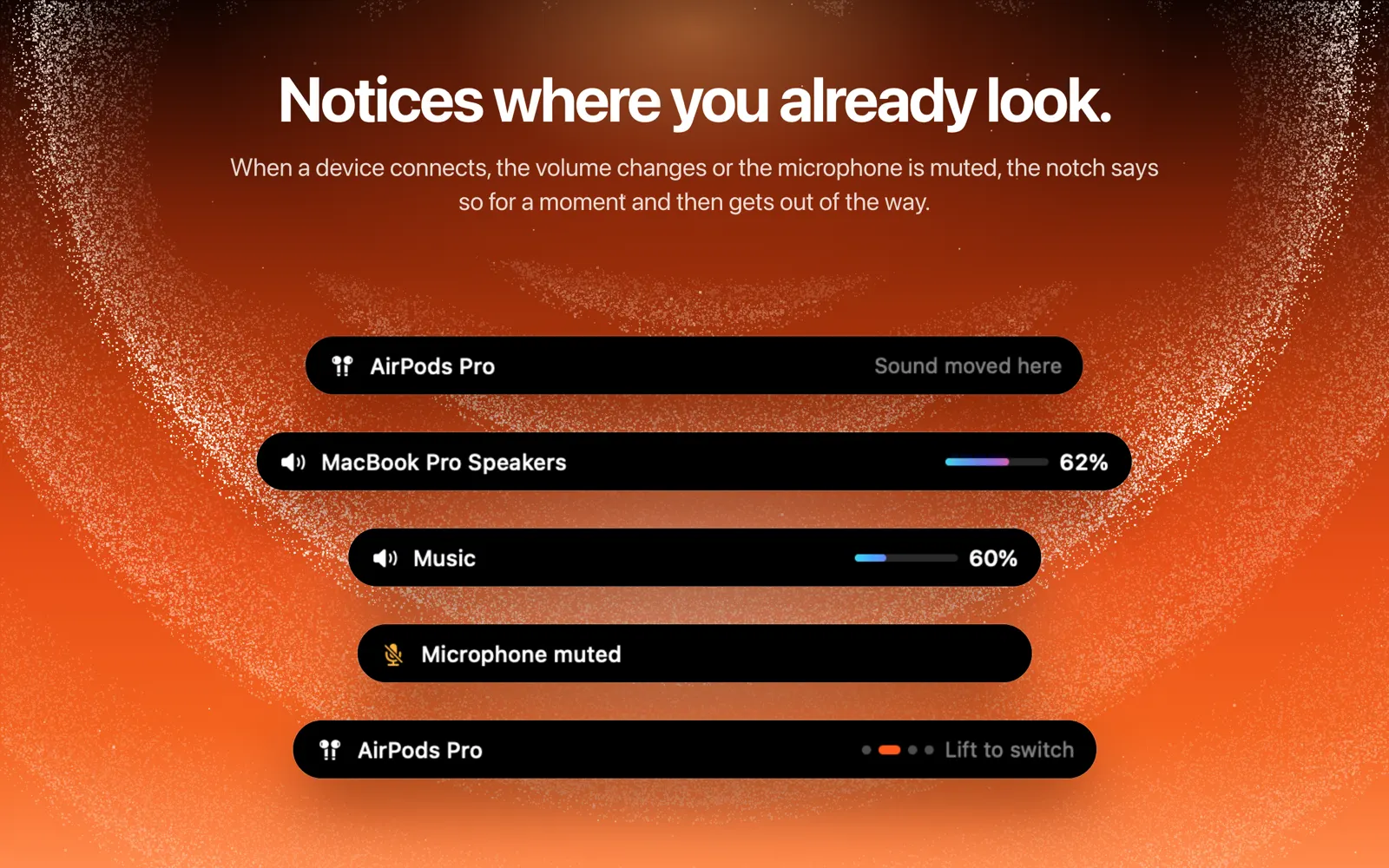
The notch also tells you things for a moment and then gets out of the way: a device connecting, a volume changing, an app starting to use the microphone.
A dial in the corner of the screen
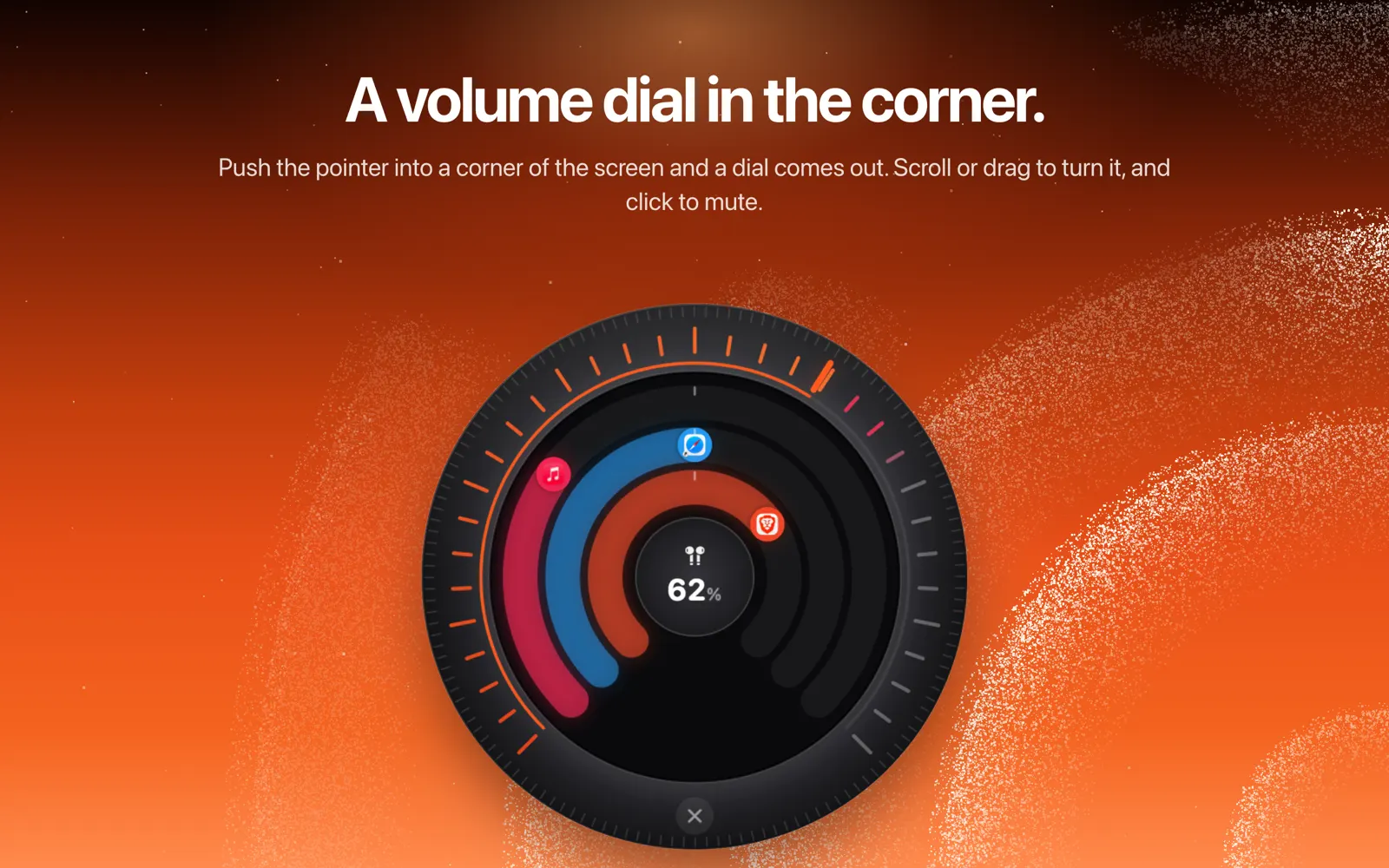
Push the pointer into a corner of the screen and a dial comes out. The rim is the Mac’s volume. Each ring inside it is an app that is playing, up to three, with the app’s icon sitting at its level. Scroll or drag to turn it, and click to mute. Pull it out by its hub and it becomes the whole knob, and it stays on screen, on every Space, until you close it.
It works with any mouse, needs no extra permission, and stays away from a corner macOS already uses as a hot corner.
On a MacBook, the edges of the trackpad work too. Slide a finger up or down the right edge for the Mac’s volume, or the left edge for the front app’s, and along the bottom edge to switch the output. The pointer stays where it was. Turn it on in Settings › Notch.
An equalizer and an output for each app
Each app has a 10-band equalizer with 11 presets, a left-right balance, and mono or swapped channels, all for that app alone. Each app can also play through an output of its own: music through the speakers and a call through your AirPods, at the same time. For headphones, import an AutoEQ curve, and it applies to all sound from the Mac.
Switch outputs automatically
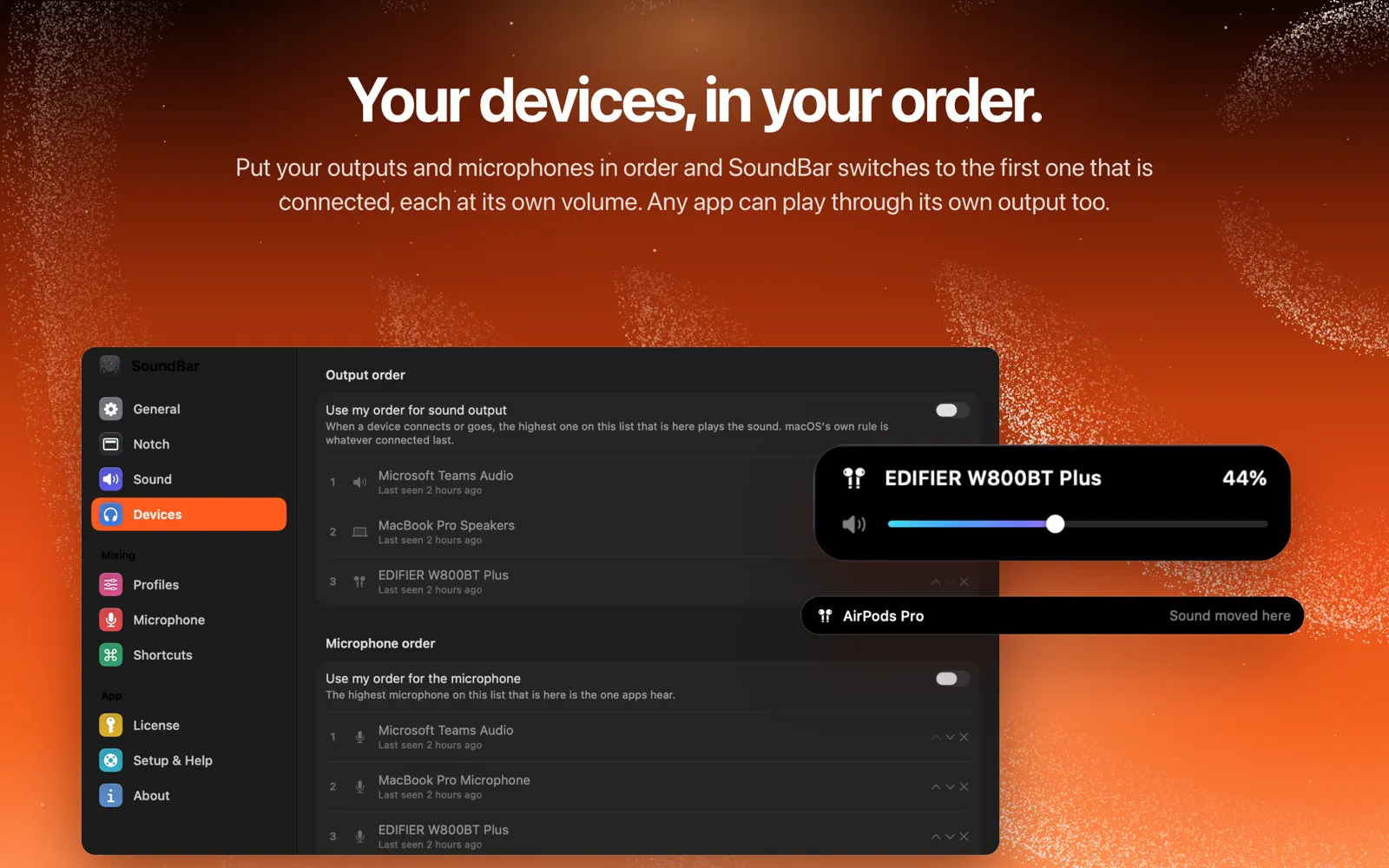
Put your outputs and microphones in the order you prefer, and SoundBar switches to the first one that is connected, at the volume it had last time, so headphones don’t start at speaker volume. Several speakers can be grouped into one output with a single volume.
Quieter apps during calls, and a night mode
When an app starts using the microphone, the other apps fade down, to 30% by default, and come back when the call ends. ⌃⌥I mutes the microphone in any app, and the notch shows that it is muted. SoundBar sees which app is using the microphone, but never reads its audio.
Night mode evens out loud and quiet passages in every app. Loudness match brings every app to the same loudness, so no app is much louder than another.
Everything on ⌃⌥Space
Press ⌃⌥Space in any app and type what you want: “mute Slack”, “Spotify 40”, “Music through AirPods”. Press Return and the notch confirms it.
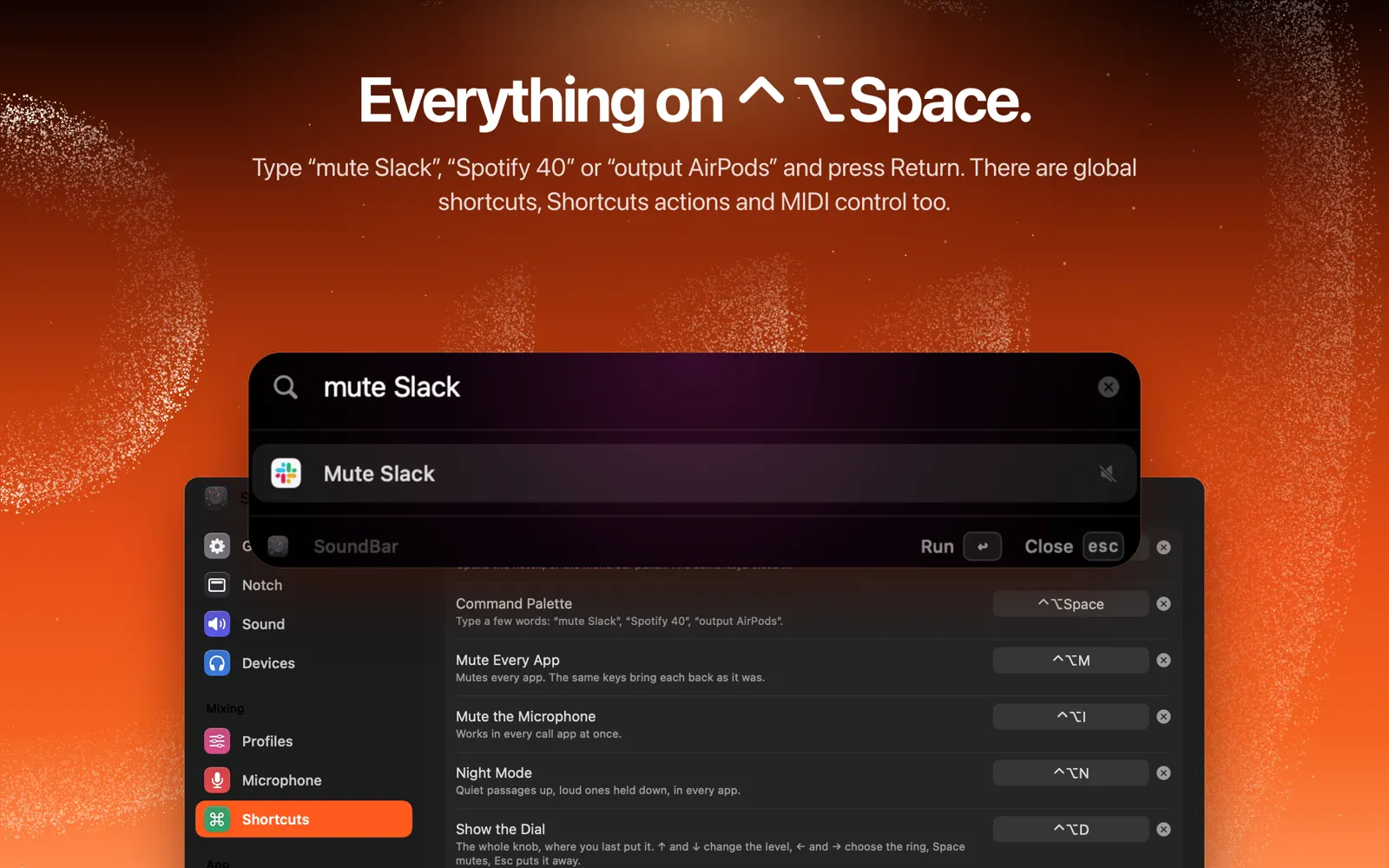
For the rest there are global shortcuts, nine actions for the Shortcuts app, MIDI control (click Learn and turn a knob or a fader), soundbar:// links for scripts, and profiles. A profile saves every volume and setting, and you can apply it with a click, when a device connects, while an app is open, or at a set time.
Privacy and requirements
To change an app’s volume, SoundBar passes that app’s sound through itself, on your Mac, as it plays, and keeps none of it. Nothing is recorded, stored or sent anywhere. There is no account and no analytics. macOS asks once for permission to capture audio, which is how SoundBar receives an app’s sound to play it at the level you set. It goes online only to check for updates and your license.
It needs macOS 15 Sequoia or later, on Apple silicon or Intel, comes in sixteen languages, and is notarized by Apple. If you use Homebrew, brew install --cask foredotstudio/tap/soundbar gets you the same app.
Pricing
SoundBar is a one-time purchase. One payment, every update for life, no subscription. The regular price is $29 a Mac.
For Black Friday, until the end of December 5, it is $6.99 for one Mac, $9.99 for two and $19.99 for five, 76% to 86% off. No code is needed. What you pay now is what you pay; the updates stay free.
There is a three-day free trial, with no account and no card, and a 14-day refund, no reason needed. Students and teachers get 25% off. SoundBar is also in Fore Plus, with Flit, Vitals and Levers, all on one key for $69.
The first days
SoundBar 1.0 shipped on November 19. Four more releases followed in two days:
- Room for other notch apps. If DynamicLake, NotchNook, Alcove or boring.notch is running when you set SoundBar up, it opens from the menu bar instead, so the two never draw over each other.
- A steadier hold on each app, including apps that restart their audio, as Chrome does.
- A clearer notch. The song and the app playing it each have a row of their own, so every slider lines up.
Every change is in the changelog.
Try it
Get SoundBar for Mac, or try it free for three days.
If an app’s slider ever stops working, click Copy Diagnostics in Settings › Setup & Help before you restart SoundBar, and email it to me.